REAL Ratings in the Real World
REAL Ratings have been out in the wild for a couple of months now, and we’ve gotten feedback from friends, family, strangers, volunteers… basically everyone. It’s been incredibly helpful to see where people are using them, how they’re interpreting them, and where the same questions keep coming up.
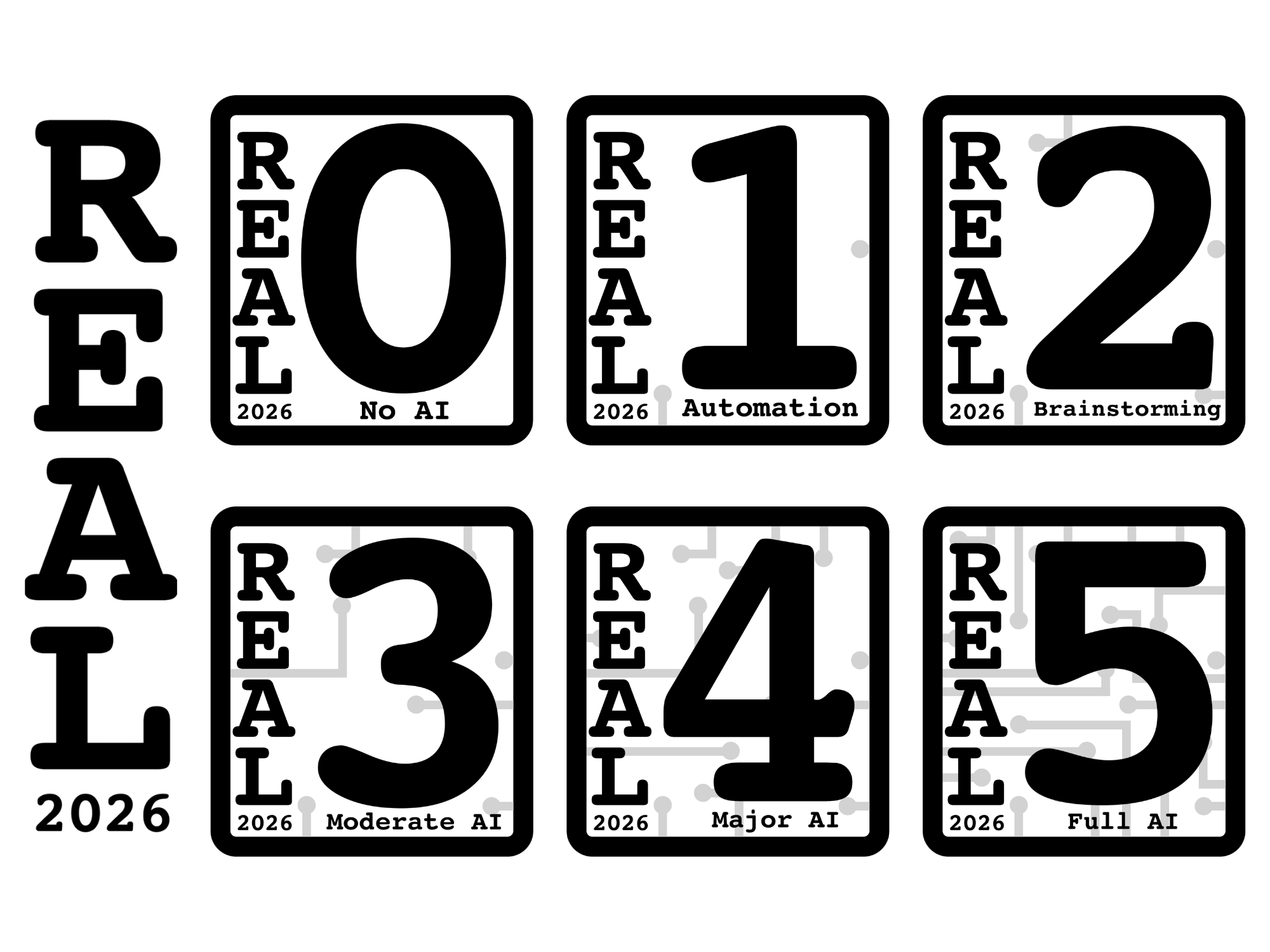
REAL Ratings measure how much AI was intentionally used in creating a final work, from REAL0: No AI to REAL5: Full AI. The scale is meant to help people describe processes more clearly, not flatten everything into a giant bucket labeled “AI.” (no shade at the people trying to make those systems)
As a general rule, a work should usually be labeled at the highest level of AI involvement that materially shaped the final result. And if AI-generated content appears in the final product AT ALL, the work is at least REAL3.
Like our girl, Haley Williams, let’s take it from the top!
REAL 0 No AI
No intentional AI usage, and no AI-powered features active in the tools used to make the work.
This is as close to untouched human-made work as you can get.
For writing, that means things like handwritten letters, essays, articles, and papers. It can also include typed work, as long as you are not using spellcheck, grammar correction, autocomplete, or other assistive tools.
It’s just you, your words, and maybe some angry red underlines you’re choosing to ignore.
For video, REAL0 means recorded and posted as-is. No editing, no captions, no color correction, no audio cleanup, no filters. Just top-of-dome to upload. If it’s a live-stream, same deal: no frills, no fancy background removal, no automated cleanup.
For visual art and photography, it means no generative tools, no AI edits, and no automated alterations doing work on your behalf.
REAL0 also means AI was not used as a reference source for the thing you made. That matters. Maybe the final object itself is totally handmade: a prop, a tool, a cake, a painting, a car, a house, ect., but if the design was based on an AI-generated image, then it doesn’t stay at REAL0. That moves it into a higher category.
REAL 1 Automation
No generative AI is involved, but assistive tools may be used to clean up, polish, or streamline the work.
These are your real ones. Your day ones. Because they’re REAL1s.
Here you’ll find things like spellcheck, grammar correction, captioning tools, color correction, audio cleanup, green screening, background removal, line smoothing in digital art software, and similar long-established assistive features. In some cases those tools may rely on machine learning, but they are not generating original content for you. These are presets, auto-adjustments, or one-click fixes that have been built and refined over years. You can apply them, remove them, tweak them, and still clearly say the core work is yours.
A lot of things that are not REAL0 will end up here, and that is normal. REAL1 is still overwhelmingly human-made work. It just includes assistive automation.
REAL 2 Brainstorming
AI is used for ideation, planning, structure, feedback, or exploration, but no AI-generated content appears in the final work.
This is where things start to get tricky.
You’re using AI as a digital whiteboard. It helps organize thoughts, outline, explore variations, get feedback, or think through structure.
But there is a hard rule: if the AI wrote it and it made it into the final piece, you are not at REAL2 anymore.
Maybe you used an AI-generated image as inspiration for a DIY build. Asked an LLM to help brainstorm an outline. Prompted for ideas, explored variations, or had AI help you think through structure. Used AI feedback to decide what you wanted to rewrite.
You can also land here if you ask AI to rearrange your paragraphs, suggest an order for your ideas, or help you think through what should come first, so long as you are the one actually doing the writing, and the AI output itself is not carried into the final product.
This is one of the categories we find ourselves explaining the most, because it is very easy to slide from REAL2 into REAL3 without noticing.
REAL 3 Moderate AI
AI-generated content is part of the final product the audience receives, but AI is not doing most of the work.
If any AI-generated content makes it into the final product, even in edited or transformed form, the work is at least REAL3.
This might be small. A sentence generated by AI that stayed in the final draft. An AI-generated title you decided was just too good not to keep. A texture, asset, or decorative element in a game that made it all the way into the shipped version. A visual generated with AI that remains part of a finished interior design concept.
This is the midpoint of the scale in the sense that AI is now materially present, but it is still not doing most of the work.
REAL 4 Major AI
AI is no longer just a background tool or a small ingredient in the final product. It is making substantial contributions that directly shape the final work. The work would be meaningfully different without that input.
This is more than cleanup. This is where AI starts acting like a collaborator, partner, or active production assistant.
You are still meaningfully involved, but substantial parts of the output are being rewritten, generated, transformed, or shaped by AI in ways that directly carry through to the final work.
This could mean asking AI to rewrite your paragraph “but make it sound smarter,” summarize your previous work into usable copy, generate sections you then lightly edit, or make structural changes that you mostly accept. You are still steering, but AI is doing a significant amount of the lifting.
A useful gut check: if a human had helped you this much, you would probably need to credit them as a co-author or major collaborator.
REAL 5 Full AI
AI did the primary generative work behind the final product.
We’re at the top end of the scale.
Whether it came from a one-sentence prompt or a giant workflow full of elaborate instructions, if AI is doing the primary generative work behind the final product, this is where you are.
You ask for the essay, the script, the artwork, the voice-over, the pitch deck, the plan, the code, the design, the post, and AI gives you the foundation or the majority of the output. You might edit it. You might rearrange it. You might revise a lot. But the core material came from AI generation. If users can interact directly with an LLM within your product, it is automatically here.
Once AI is the main creator, it is REAL5.
A Couple of Examples
To make this more concrete, it helps to look at how the same task can rise through the levels depending on how AI gets integrated into the workflow.
These examples are not moral judgments. We are not saying which levels you should or should not use in different situations. We are just showing how a project can move up the scale.
Example 1: Writing an essay for school on the history of AI
REAL 0
You pretend you live in the dark ages and write by candlelight. You write on pen (or quill) and paper. Just you, your knowledge of the history of AI, and your suffering…
REAL 1
This is probably the most common version for someone living in this century who is not going out of their way to use AI.
You write in Google Docs or a similar editor and use tools like spellcheck or grammar correction for small mistakes. You might search the web for facts, but you avoid AI summaries and use regular sources to gather information. The writing is still yours. The facts come from sources you locate and verify yourself.
REAL 2
In this scenario, you open up your favorite LLM like Claude, ChatGPT, Gemini, local LLM, or similar.
You ask: “What does my professor expect when they ask me to write a 1,000 word essay on the history of AI?” Then you read what it says for inspiration on the structure and beginnings of content for the essay.
You followup: “Can you give me 10 benchmark papers that would be important to include?”
Then you hit google to find these papers (if they really do exist) and do your own reading and writing about them.
Note, you are NOT doing any copy-pasting from the LLM to your writing document.
When you’re done and you feed your essay back into the LLM and ask: “What feedback would you provide to a student on this essay that would take it from where it is to an A+?”
Then you look at the advice from the LLM and ONLY YOU touch your document, again with NO copy-paste.
Finally, you’re satisfied but still need a title!
You ask “Can you give me ideas for 10 titles for this essay?”
You look at these and no one idea hits fully. You take some combinations of the titles and come to a better one than any of what the LLM suggested.
If you cite or use facts recommended by the LLM, they come or were verified from other sources outside of it.
At this level some ideas or structure has been helped by AI, but no generative AI is in the final product.
REAL 3
Some AI-generated building blocks make it into the final text.
Maybe one of the titles the model gave you was just too good not to keep. Maybe you kept a sentence or phrase. Maybe some AI-generated wording survived into the final draft even after you edited around it.
It is not a fully AI-written essay. It is still mostly yours. But AI-generated content is now part of the finished work.
REAL 4
AI is doing substantial co-writing or revision work.
You prompt: “Rewrite this paragraph but make it sound smarter.” Or: “Take this 20-page paper I wrote before and summarize it into one paragraph I can use in this essay.”
Or you give the LLM your full essay draft and let it rewrite sections, smooth transitions, improve clarity, or reshape the structure, and then you paste those revised sections back even with review.
The essay is still connected to your thinking, but AI is doing major generative work on the actual final wording and structure.
REAL 5
Oh no! The essay is due in an hour.
So you ask: “Write a 1,000-word essay on the history of AI.”
Maybe you get fancier about it and break the task into prompts for outlining, drafting, revising, and polishing. Maybe you feed it sample essays. Maybe you swap paragraphs around and make some edits after the fact.But the essay fundamentally came from the model and you’re at REAL5.
Example 2: Making a YouTube video
REAL 0
You record your video and upload it essentially untouched. No captions, no color correction, no audio cleanup, your thumbnail is a screenshot, no background removal, no transitions. Just camera on, camera off, upload.
This is honestly very hard to do.
Possible? Yes. Common? Not really.
REAL 1
You record your video, trim dead space, adjust the color, clean up the audio, add captions, maybe blur something in the background, remove background noise, use standard editing presets or auto-correction tools built into your software. You make a thumbnail yourself in Photoshop, Canva, or another editor using non-generative tools.
That is still REAL1. These are assistive and automated production tools, not generative AI creating core content for you.
REAL 2
AI starts helping shape the process, but none of its generated output makes it into the final upload.
You ask AI to “brainstorm title ideas, thumbnail concepts, hook variations,” or “a better order for my talking points.” Maybe you ask for feedback on your script, or for help deciding where your pacing drags. You ask it to “help plan B-roll ideas and segment structure.”
But then you make the actual final script, visual choices, edit decisions, and assets yourself.
No AI-generated script lines, no AI-generated voice, no AI-generated images, no AI-generated music, and no AI-generated thumbnail elements.
REAL 3
AI-generated material appears in the final product.
You kept one AI-written line in your script. Your thumbnail includes an AI-generated background image. You used AI voice enhancement that crossed over into generative reconstruction. An AI-generated graphic, animation, or bit of music ends up in the final cut.
The AI contribution may be small, but it is now part of what the audience actually receives.
REAL 4
AI is doing significant production work.
You draft your whole script and ask AI to: “rewrite it for clarity, punch, or retention.” and then copy and paste it back into the teleprompter, or original document.
You use AI tools to generate major visual elements for the thumbnail, create multiple on-screen graphics, produce voiceover sections, and/or meaningfully reshape the package with AI-generated creative decisions baked in.
You are still directing the project, but AI is now a substantial creative and production collaborator.
REAL 5
AI is doing the actual making.
You ask AI to “write out a script, generate a voice and visuals.” “generate music” “generate the thumbnail.” Even use AI avatars or AI-driven editing to assemble most of the finished video.
At that point, your role is prompting, selecting, curating, and publishing. The final product is generated by AI.
The point of REAL Ratings is not to flatten everything into “AI” or “not AI.” That’s not how people actually work anymore, and it’s not a useful way to talk about the creative process.
It is to give people a clearer language for disclosure.
Someone can be anti-AI and still find the distinction between REAL1 and REAL5 meaningful. Someone can be pro-AI and still want a way to communicate when a work is mostly human-made, AI-assisted, or heavily AI-generated.
The ratings help people describe processes, without picking sides.
That matters for artists, students, researchers, and consumers. It matters for people hiring, commissioning, teaching, publishing, documenting, and deciding what kind of work they want to support.
REAL Ratings are meant to make those conversations easier, more specific, and more honest.
The more we see REAL Ratings used in the real world, the more convinced we are that people want nuance. They don’t just want a giant bucket labeled “AI.” They want to know how AI was used, where it was used, and how much of the final thing actually depended on it.
That is what this system is trying to give them.
And the more people use it, test it, push on it, and argue with it a little, the better it will get.